Showing posts with label camel. Show all posts

Thursday, August 6, 2020

The Birds and Animals Souk of South Jeddah

In Saudi Arabia, there are many specialized souks (markets) for whatever you may be looking for.  There is a big fresh fish market with daily auctions, textile souks for everything from sheets to carpets and fabrics, and there are souks for housewares, gold and jewelry, spices, computers, crafts, and well, just about everything under the sun!


This past week my husband took me to a souk I hadn't ever been to before in the more than twelve years since I have been here in Jeddah - the Live Birds and Animals Souk.  It's a really large souk, encompassing many square blocks of an area far south in Jeddah. My husband wanted to purchase some birds - he was having a craving.


The bird section was actually a little disappointing and it wasn't as well stocked as the times my husband has been there before.  Perhaps it was due to the virus or the fact that it was a few days before a big holiday here, when the main focus is on lambs and goats.  It was also difficult photographing the birds because many were in cages and I had a hard time focusing. 


The bird section offered all kinds of birds, from chickens and roosters to turkeys and pigeons, and many varieties that I didn't know the names of.  There were also bunny rabbits in this area of the souk as well.  Conveniently located in the same area was a butcher, who cleaned the purchased animals for a very reasonable fee, as well as stations selling charcoal and firewood.  My husband bought two pigeons for 15 SR ($4 US) for both, and the fee to have them cleaned was 2 SR each (50 cents US). 


Thousands and thousands of lambs and goats were in the next section of the souk we visited.  Because of the upcoming holiday, Eid al-Adha, the Feast of the Sacrifice, there was an abundance of livestock available, likely imported for this holiday from Europe or Northern Africa.


The Eid al-Adha holiday occurs at the conclusion of the annual Hajj pilgrimage, a huge celebration feast of sharing.  Normally millions of pilgrims travel to Mecca each year for Hajj, however this year due to the virus, only about 1000 pilgrims from within the kingdom were permitted to attend.  All international flights to and from the kingdom have been suspended indefinitelyfor several months now. 


According to Wikipedia, Eid al-Adha "honours the willingness of Ibrahim (Abraham) to sacrifice his son Ismael as an act of obedience to God's command. But, before Ibrahim could sacrifice his son, God provided a lamb to sacrifice instead. In commemoration of this intervention, an animal, usually a sheep, is sacrificed ritually. One third of its meat is consumed by the family offering the sacrifice, while the rest is distributed to the poor and needy. Sweets and gifts are given, and extended family are typically visited and welcomed."


Some of the animals available at the souk had remnants of their winter coats visible. For the most part, the animals were separated by types.  Many were "branded" with spray painted symbols on their fur. The cost of a sheep is dependent on its size and type, ranging in price from 800 SR to 2000 SR ($213-$533 US), but is slightly higher during the holidays, priced from 1300-2500 SR ($346-$666 US). 


We also saw camels and cows in the third area of the souk that we visited that day, but we didn't get close enough for me to get any good photos of the cows. Going to this souk was actually a special treat, as my husband and I have still been isolating because of the virus. 

If you are interested in visiting this souk, you can find the location on Google Maps by typing in "Jeddah Birds and Poultry Market" or "Jeddah Cattle Market."  The photo below shows the signs at the entry to the Birds and Animals Souk.


Wednesday, March 14, 2018

Along the Road from Jeddah to Yanbu


During our recent road trip from Jeddah to Yanbu for the annual Yanbu Flowers and Gardens Festival (CLICK HERE to see photos of the amazing event), we were treated to some very typical Saudi visual sights along the way.  The drive from Jeddah to Yanbu should take about three and a half hours, but sometimes it takes us as long as eight hours because we like to stop at the interesting sights along the way!

On this trip, desert vendors were out selling their wares in full force - and as it was the height of watermelon season, we saw many watermelon vendors setting up shop on the sides of the highway.


Some of the desert vendors have some pretty sweet set ups for their time out in the heat. Some had erected nearby tents for respite from the sun or to take a nap - some tents are even equipped with air conditioners!  A few had a grill where they could heat up water for tea or even barbecue their lunch if they were so inclined.  Almost all desert vendors are sure to bring along their carpets so they are more comfortable all those hours on the desert floor.  CLICK HERE to see more photos of the watermelon season in Saudi Arabia.


We also saw lots of sheep grazing in the rain fed patches of green, being tended to by shepherds.  Sheep are raised in Saudi Arabia to provide lamb, the most preferred meat for Muslim holidays.


Other desert vendors sold pottery or other items.  My husband likes to haggle with them about their asking prices - a talent he acquired growing up in Jeddah at a time when haggling was commonplace.


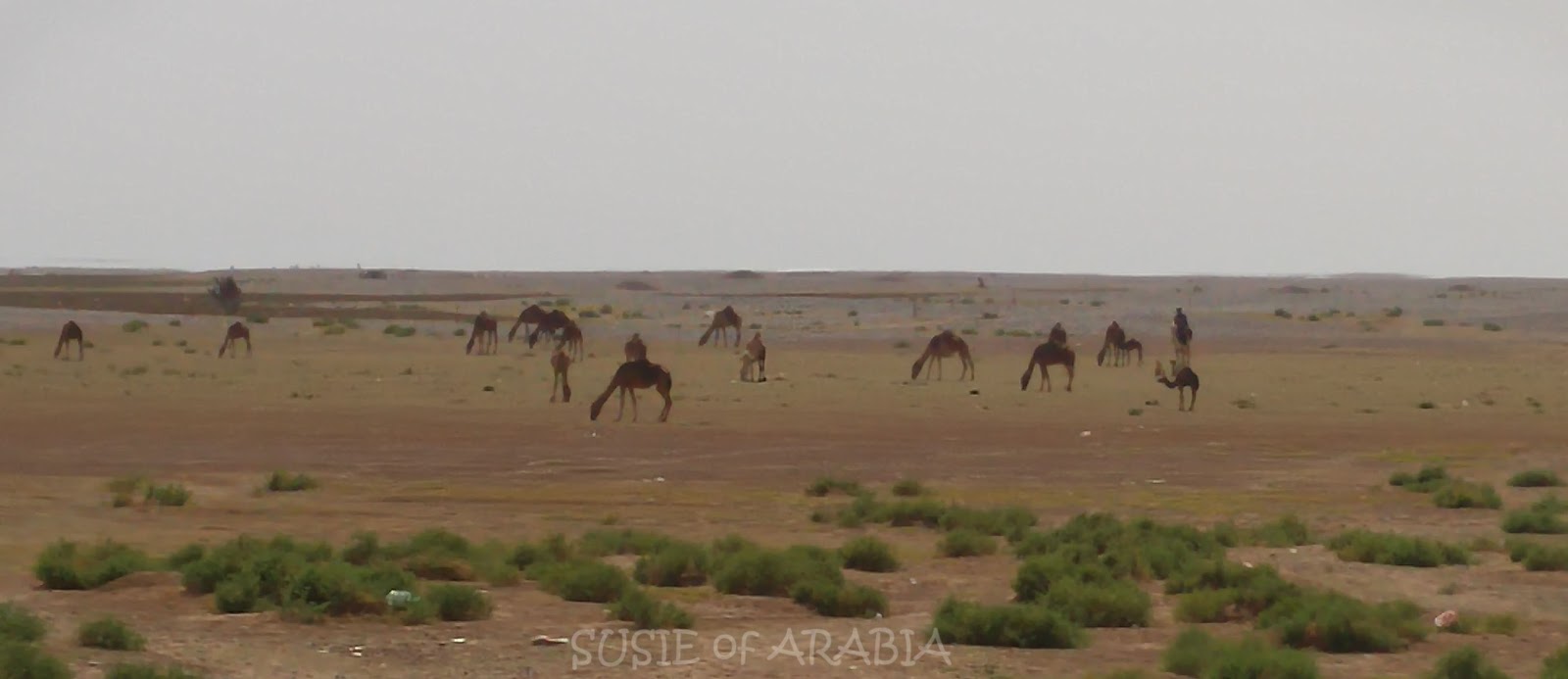
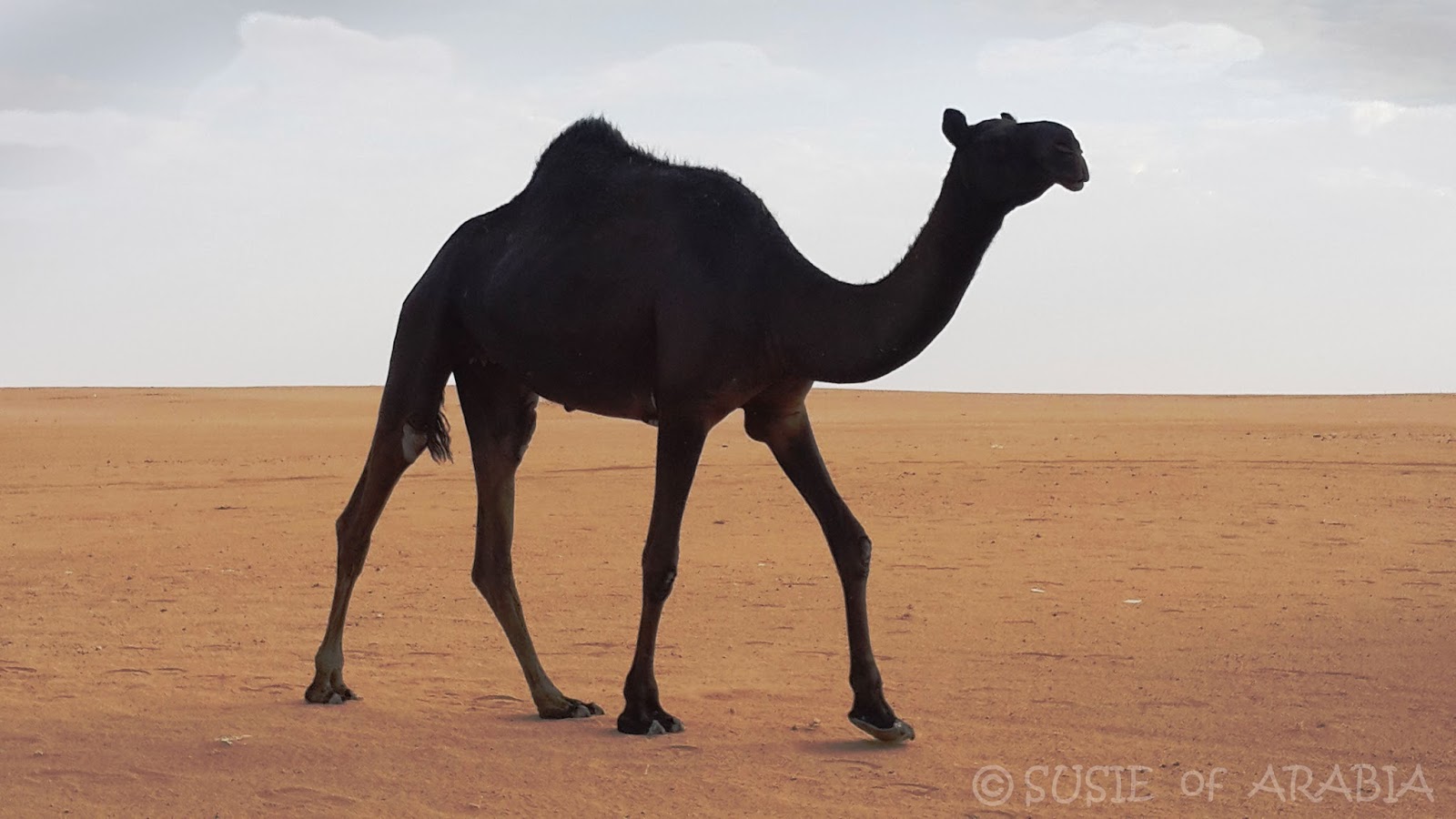
Then we started seeing the camel crossing signs.  I have to tell you, in all our drives along this road, this time we saw more camels along the freeway than any other time before.  I was in camel heaven!


We even saw a large herd of the more rare white camels.  It was pretty exciting to see so many white camels all at once like that.  And the baby camels were so cute!


I've heard some people say that the drive between Jeddah and Yanbu is boring and there's nothing to see.  I totally disagree!

Sunday, November 16, 2014

Enchanting Najran - Saudi Arabia

Last month I took a little trip down to the city of Najran, in southern Saudi Arabia near the Yemen border. The fascinating history of the area, the friendly people, along with the varied geography make this place a must-see destination for any expat living in Saudi Arabia.


Najran is nestled in a fertile farming valley surrounded by rocky mountains and rolling deserts. The abundance of date palms adds to the scenic landscapes and provides a visual treat for the eyes. Farming is an important industry in Najran, with fields of crops stretching for miles. The fertile soil is suitable for growing crops such as corn, wheat, zucchini, and a wide variety of fruits like apples, peaches, citrus, and grapes.


Coupled with the distinctive architectural style of the region, Najran is a city that magic carpet dreams are made of. All over Najran, mixed in with the new construction, are the unique old mud and straw houses, some of them in ruins, but many of them not only standing, but still inhabited. Another distinguishing feature of these homes is the decorative white "bride's lace" designs at the roof lines that add unmistakable charm to the buildings.


Our group was invited into one of these modest mud homes by lifelong residents Ahmed, who is in his 80s, and his wife Umm Mohammed. They were gracious hosts, offering us the traditional gahwa (Arabic coffee) and dates which we enjoyed in their sitting room. We toured the home from bottom to top, viewing the fields and mountains from their various rooftop decks about 4 floors up. Because of its close proximity to Yemen, many of Najran's residents are of Yemeni heritage, as are Ahmed and his wife, and the architectural style of the mud homes is also an influence of Yemen.


Camels are everywhere in and around Najran. The camel souq is where camels are bought and sold, along with fresh camel milk. On our excursion outside the city into the desert, we saw many groups of camels that were being trained to compete in races. We were also treated to a Bedouin cookout one perfect evening under the stars at a desert camp, complete with carpets, tents, camel meat, hookahs, and a campfire. The only thing missing was the marshmallows!


A highlight of our trip was a visit to the main souk of Najran which houses a dagger souk. The traditional curved Arab daggers, called khanjar, are offered for sale here, with elegant carved handles made of bone, metal, wood, or plastic. The men of the dagger souk all proudly wore their traditional Arab clothing, accessorized with their khanjars strapped around their waists on a leather belt. Another section of the souk offered products like handmade baskets, jewelry, and clothing.

Men of the dagger souq - Najran, Saudi Arabia


Several of the dagger shopkeepers took turns posing for photos with me. It felt like the paparazzi was around as the others all gathered around us to take photos with their state of the art phones.  I could tell by the frequent laughter that jokes were being made as we posed for pictures. Later I learned that the conversation went something like this:
"Mohammed, you better not let your wife see that picture of you and this woman. She will get jealous."
"You've been thinking of getting a 3rd wife - how about this American?"
"My wives will kill me if I do that!"


Even though people have lived in the Najran area for about 4000 years, it is considered to be a newer and more modern city because of its remarkable growth spurt since the 1970s.  Najran's population now exceeds 250,000.  We toured the historic Emara Palace, built in the 1940s - a fine example and tribute to the distinctive architecture of the region.  Another well known palace in the area, Al-Aan Palace, is built on hilltop and offers spectacular views of the surrounding area, overlooking the oasis of Najran.

Emara Palace - Najran, Saudi Arabia


Interestingly enough in pre-Islamic days, Najran used to be inhabited by predominantly Jews and Christians. There is an old archaeological site in the city that bears the ruins of Al-Okhdood (also spelled Ukhdood).  According to a story in the Q'uran, this is where a disgruntled Jewish king massacred thousands of its residents by burning them alive because they converted to Christianity. Quite a gruesome history.   Rock drawings of animals and cryptic writings are visible all over Al-Okhdood. The site is still in the process of being excavated and to date has produced important historical artifacts, with much more still hoped to be retrieved.


Spectacular scenery and fascinating history aside, what really makes Najran such a memorable place is its people. Warm and welcoming, open and friendly, the people of Najran are hospitable and accommodating.


If you are interested in planning a trip to Najran, I highly recommend Mohammad of Najran Tours. He is professional, knowledgeable, and flexible and will tailor your visit to your preferences. Here is the information for Najran Tours:

Mohammad H. Al Mustaneer
Najran Tours.
Reg. No. : 5950026097
Najran, Saudi Arabia
Mob. +966 552 498 012
+966 550 377 715
najrantours@gmail.com
www.najrantours.com
Facebook page for Najran Tours

Tell him Susie sent you!

I put together a slideshow for you with lots more photos from my trip to Najran.  Enjoy!


Friday, April 26, 2013

A Real American Bedouin

Erga Rehns was born in Palestine in 1935.  She was raised in New York, lived in Portugal, and lived among the Bedouins in the desert of Wadi Rum in Jordan.  This post contains two videos from 2007 that were posted by Al Jazeera about her life in the desert.


Feeling the need to return to her roots and a simpler life, Erga had lived for seven years in the Wadi Rum desert when this record of her bedouin lifestyle was first presented.   She outlived two husbands prior to her move to Jordan and in the video shares a story about receiving a marriage offer from a Bedouin man when she was 70 years old. 


Thursday, July 7, 2011

My Niece Louisa in the Sahara

My niece Louisa, a university student, is spending part of this summer in Morocco taking an intensive Arabic language course. She started blogging about her experiences on her blog called "On the Streets of Fes."    Her latest entry, "A Trip to the Sahara," is an interesting account of a trip to the Sahara with great photos which I thought you would find interesting...


This weekend turned out to be the most amazing weekend of my life. It was the Sahara Trip, which was organized by the school so about 30 students all went. We drove about 7 hours through the Moroccan country side which was amazing in itself. Our destination for the day was a luxury hotel in the middle of nowhere. At this point in the program, everyone was hot, tired, and a little bit sick of their homestays. This hotel was absolutely amazing. It had two pools, a disco, and real showers. The food was amazing and we pretty much had the hotel to ourselves. After a night of drinking and swimming, we were able to sleep in and then the next morning we took off again for our second destination. We stopped at the Kasbah Tombocktu and swam while we waited for the sun to get lower in the sky.

Around 6 pm, we started loading onto the camels. Please take into account that camels are not the most beautiful animals and they also make odd sounds. Once I put one leg up onto my camel, it immediately stood up, which caused me to lurch forward to the top of its back. Finally I was settled and I tried to ignore the camel behind me which was slobbering on my leg. Camels are extremely uncomfortable to ride and they are roped together in groups of 3-5 with a Berber man walking in front.

The Sahara is amazing. The red and yellow sand in huge dunes around you for as far as you can see. There are snake and scorpion tracks in the sand and when we stopped to watch the sunset, we climbed one of the dunes and took in the beauty around us.

We reached the Berber Oasis shortly after sunset and were welcomed to rugs laid out on the sand with tents in a circle. The Berbers served us tea and a few of us climbed up the huge sand dune behind the camp in hopes of sand skiing. We ate dinner at ridiculously short tables and then listened to some of the Berbers drum and sing. Since we were in the middle of the desert, there were no lights except for the candles set up around the camp. This way, we could see thousands of stars. The entire Milky Way was visible and there was no moon, which made it especially dark. We started dancing to the Berber drums and I was extremely happy. After, a few of us sat down with some of the Berber guys and started to talk. I realized they all spoke Spanish so I was thrilled that I could communicate with them. I met Asou, who was 21 and lived in the larger town near the hotel. He has been leading camel treks for 10 years in the Sahara and knew about 5 languages just by listening to visitors in the desert.

My friend Gabrielle and I made our way out to the “bathroom” and on our way back, we ran into Asou and another Berber guy. They explained that they were about to climb the dune behind us which was about 600 meters and made completely of sand. Gabrielle and I looked at each other, shrugged, and followed these guys up the side of the mountain. At this time, it was pitch dark, none of us were wearing shoes, and the dune was just about as steep as possible. Every step you took, you slid down another step. After about an hour or an hour and a half, we reached the top. The view was absolutely breathtaking. Since this was the tallest dune for miles and miles, you could see everything. To the North, there was a small town with lights. To the South, hundreds of meters below us, was the camp, which was impossible to see because it was very late at night and all the lights were out. To the East, you could see the black mountains that made the Algerian border and to the West, you could see the dunes going on and on for hundreds of miles.


It was the most incredible experience being able to stand on the very tip of this dune, by ourselves and get caught up in the Sahara wind watching hundreds of shooting stars. We spent the entire night up there, walking on the ridges of the dunes and learning words in the Berber language. At 4:20am, the mosque in the town to the North announced the call to prayer. This consisted of a flashing light from the mosque and the call which you could faintly here through the wind. Around 4:30 am, the guys had to head down the mountain to start getting the camels ready because the sun was about to rise. We sat up there as other students from our camp slowly made their way up to where we were sitting. They were amazed and jealous that we had spent the night up here and watching the sunrise was incredible sitting there with all of our friends. After the sun rose, we quickly jumped and slid down the mountain so that we could get back before the heat set in. I was so tired on the camel ride back that I actually fell asleep at one point, which I thought was impossible. We arrived at the hotel, showered and ate, and then started the long drive back to Fes. As I am writing this, I am sore everywhere, dehydrated, and exhausted but I am extremely lucky to have had this experience and I will never experience my night on the top of the dune for as long as I live.

To see more photos from Louisa's trip and to read more about her experiences so far, please check out her blog, "On the Streets of Fes."

Monday, December 6, 2010

The Life of a Camel Herder


Just a few minutes by car from the busy seaport city of Jeddah, Saudi Arabia, are many outposts where the native one-hump dromedary camels live, herded in by rickety barbed wire corrals. Fresh and frothy warm camel’s milk is available for sale (about $5 US per gallon), and for very special occasions, one can also buy whole camels for their lean meat as well (about $1000 US).


However some camels can fetch a much higher price for their great beauty – earlier this year at the famous King Abdul Aziz Festival, the camel beauty contest offered prizes totaling 70 million Saudi Riyals (that’s 14 million Euros).


But this story is about Hussan. He is from Sudan and he is a camel herder. He is a content man with simple needs, not many worries, and very limited means. His cheeks are freshly shaven and his graying mustache and beard are neatly trimmed. He has beautiful white teeth and a ready smile. I have to admit that not all the camel herders I have seen here are as clean and well kempt as Hussan.


Hussan and several other men from Sudan take care of a herd of probably more than a hundred camels altogether. They feed and water the camels every day and milk them on the spot when a customer comes by and requests fresh camel milk, which is arguably a healthier alternative to cow's milk. It is very nutritious, and compared to cow's milk, is higher is Vitamin C and is more easily digested, which makes it better for those who are lactose intolerant. Another interesting fact about camel's milk is that is doesn't curdle! It also has wonderful health benefits, such as controlling diabetes due to its high concentration of insulin and being great for one's skin because its content is so high in fatty acids like lanolin. Camel milk is an important dietary staple for many people in the world.


The camel herders live out in the scorching desert heat with the camels that they tend, in very primitive and simple living arrangements.


Not far from the stately luxurious palaces and the spacious tiled villas of Jeddah is where Hussan and the others live on the outskirts of the city. It is just a few feet from where the camels sleep in their barbed wire corrals. The camel herders’ shelter is built from odd and ends of discarded wood, plastic and canvas tarps, and several large old prayer rugs. If you look closely, you can just barely see part of an old Saudi style bed frame where he sleeps. I saw at least one more bed inside, and there might even be a third. The beds are elevated from the desert sand floor and are covered with old bedding.


The harsh climate of Hussan's humble desert abode must be brutal for him to tolerate especially in summer’s hottest months, yet his warm smile and polite demeanor always greet his customers unfailingly. I saw large water jugs about, but I'm not sure how or where he and the others bathe. I also noticed a large white tent nearby that might possibly be used for their toiletry needs, and there were buildings off in the distance, including a mosque, not too far of a walk away.


Several of these makeshift shaded bunks where the camel herders nap were here and there, crudely built of old pieces of wood and draped with various fabrics and bedding. You can click on the photos to enlarge them, and in this one you can see one of the guys actually napping inside the shaded bunk.


I also saw in the surrounding desert area several pieces of dusty old discarded furniture that the camel herders could use for resting. It's common to see old furniture outside apartment buildings and businesses in the city, where the building caretakers can sit.


The life of a camel herder must be very tough and physically grueling, but from all outward appearances, they all seem very happy to me. There is something to be said for their non-materialistic simple lifestyle without the pressures and trappings of a modern-day existence.