Showing posts with label news. Show all posts

Wednesday, May 28, 2014

Getting Away with Murder

Farzana Parveen Iqbal was a 25 year old Pakistani woman who was excited about her pregnancy and becoming a mother.  Farzana had chosen to wed a 45 year old widower she had fallen in love with, instead of the cousin her family had selected for her to marry. 

Charges were brought against Farzana’s husband, Mohammad Iqbal, who was accused by her family of kidnapping her and forcing her into marriage.  Farzana was on her way to testify in court that she loved her husband and married him willingly. 

As the couple arrived at the Lahore, Pakistan, courthouse on Tuesday, May 27, a crowd gathered around to watch as the pregnant Farzana was stoned with bricks and clubbed to death by several of her male relatives, including her own father and brothers. She died of severe head injuries.

Mohammad Iqbal, right, husband of Farzana Parveen, 25, sits in an ambulance next to the body of his pregnant wife who was stoned to death by her own family in Lahore, Pakistan.(Photo: K.M. Chaudary, AP)

I’m glad I wasn’t born in a place like Pakistan, where an average of 1000 women are murdered every year at the hands of the men in their families defending their “family honor.”  What is even more appalling is the fact that these killings are tolerated and even dismissed by the courts and government of Pakistan.  If men are arrested and tried for these crimes, even if they are found guilty, punishments are often extremely light or non-existent. 

In fact, the way the Pakistani system is set up with regard to murder or accidental deaths, by law the victim’s family can forgive the killers.  This opens up the world of honor killings to abuse.  “The law allows (the family) to nominate someone to do the murder, then forgive him,” in essence allowing the murderers to get away with murder.  Honor killings usually specifically target women or homosexuals.  The broad and flimsy reasons given to justify honor killings range from imagined or real sexual encounters, rape victims, divorce even if the wife is being abused, refusing arranged marriages, to just merely appearing to enjoy oneself in public. 

A family member of the pregnant woman stoned to death by her family wails over her dead body in an ambulance in Lahore, Pakistan. AP Photo/K.M. Chaudary

What kind of a father kills his own daughter because he feels insulted by her choice of husband?  What kind of father would rather kill his own daughter than see her happily married to a man of her own choosing?  Don’t we all, as parents, really only want our children to be happy?  What is wrong with a society that places “perceived family honor” over the happiness or freedom of a woman to live her own life and make her own choices?  


On a final note, Islam denounces honor killings.  It is a patriarchal and cultural practice with no base in religion. 

Let me say it again:  I AM GLAD I WAS NOT BORN A PAKISTANI WOMAN!

Tuesday, March 26, 2013

Saudi Women: Changing Reality, Making History


Assumptions are made about Saudi women all the time - faceless, nameless women hidden away by their own society.  The main reason for these suppositions is based solely on their seeming invisibility and nonexistence due to their homogenous veiled clothing.  But in the five short years (or long, depending on how you look at it) since I moved to Saudi Arabia, I have seen changes and accomplishments achieved by Saudi women at an accelerating warp speed that I could have never imagined…     
  
For example, last summer a group of 11 Saudi women reached the base camp of Mount Everest in an effort to raise awareness for breast cancer.  Their journey was even more remarkable for the fact that they were the first Saudi women ever to climb the world’s highest mountain and to accomplish such an arduous feat.   Leading the expedition was HRH Princess Reema Bandar Al Saud, a motivated and driven modern Saudi woman who supports many charitable causes, chief among them being breast cancer research and awareness.  

Team of Saudi women who climbed Mt. Everest in 2012

Politically there have been some sweeping and historic changes for women in KSA.  For the first time ever, thirty Saudi women were recently sworn in to the Shura Council, the prestigious but virtually powerless consulting advisory board to the king.   Women have also been given the green light to vote in elections in the year 2015. 

When I first moved to KSA in 2007, the only fields women were allowed to work in were education and medicine.  This meant that women were put in the demeaning and uncomfortable position of having to purchase intimate apparel, cosmetics, and abayas from salesmen.   Reem Asaad, a successful Saudi financier, wife and mother, conceived of and spearheaded an effective three year long campaign which made the King himself sit up and take notice, with the end result changing the face of retail establishments in Saudi Arabia and upping the number of women in the work force by leaps and bounds.   

Saudi women's rights activist Reem Asaad

In the 2012 Olympics, two Saudi women made history by becoming the first ever female athletes to compete representing Saudi Arabia.  Although the circumstances surrounding their involvement in the Olympics bordered on extortion - KSA was forced to cave in to pressure by the Olympic Committee’s very real threat of disallowing the kingdom’s male athletes if females were not allowed to participate    (heaven forbid if Saudi men were deprived from competing!) -  these two token Saudi women definitely created the most buzz and attracted the most attention of any athletes at the Olympics.  


Saudi female athletes at the 2012 Olympics

Another Saudi woman made pioneering history this past year when she became the first Saudi filmmaker to produce a feature movie filmed wholly within Saudi Arabia.  Haifaa Al Mansour’s film Wadjda has been warmly received by audiences around the world and tells the tale of a young girl who has a simple but forbidden dream - owning and riding her own bicycle - and how she courageously stands up for herself, and in effect, for oppressed females everywhere.  Director Al Mansour met with challenges and difficulties while filming the movie, resorting to directing her crew by walkie-talkie from inside a nearby van out of fear that there would be problems if she were seen giving directions to the male members of her crew in public.    


Saudi filmmaker Haifaa Al Mansour

Okay, so women are still not permitted to drive yet in the kingdom, but I do feel that progress is being made in this area.  From all appearances, measures are being taken in preparation for women driving in Saudi Arabia to become a reality.  The Shura Council has agreed to take the matter of women driving under advisement.   Manal Al Sharif garnered worldwide attention and became the face of the women’s driving issue when in 2011 she was jailed for ten days for daring to drive on the streets of Saudi Arabia.  She has since received numerous honors and awards from organizations around the world.  

Saudi women's right activist Manal Al Sharif

So next time you think Saudi women are oppressed, think again.  

I’ll end this post with a popular anecdote about Bill Gates giving a speech in Saudi Arabia to an audience that was segregated by gender – men on one side and women veiled in black on the other side of a separating partition.  After Mr. Gates spoke, there was a question and answer period.  Someone asked if Gates thought it was realistic for Saudi Arabia to aspire to being one of the Top 10 countries in the world in technology by 2010.  “Well, if you’re not fully utilizing half the talent in the country,” Gates said, “you’re not going to get too close to the Top 10.” 

And how did the audience react?   “Well, one side of the room loved it,” quipped Gates.

Sunday, March 17, 2013

UPDATE: Where is Khaled?

Almost two years ago in the midst of the Arab Spring, I posted a video of a Saudi man named Khaled.  He had shown up for a planned protest on the streets of Riyadh - but he was the only one. Khaled spoke to a BBC News crew that was there waiting for anything to happen that day, amidst the muscle of an overwhelming police presence. CLICK HERE for my original post about what happened, along with the video of Khaled speaking.

Khaled Al-Johani disappeared shortly after he spoke on tape to the journalists. News reports labeled Khaled “the bravest man in Saudi Arabia.”  For almost one year he languished in a Saudi prison, deprived of access to legal representation, held without charges, and denied a speedy trial. In February 2012 in a court established to handle terrorism cases, he was finally charged with "support of demonstrations, presence at the location of a demonstration, and communications with the foreign media in a manner that harmed the reputation of the Kingdom of Saudi Arabia."

It appears as though Khaled was temporarily released from prison and was able to spend four months with his family – before he learned the verdict in his case and his fate: his sentence is eighteen months in prison.

Saudi human rights activist Abdullah al-Hamid, who himself has just been recently sentenced to a five year prison term for voicing his political opinions openly, tweeted: “The sentence on Khaled al-Johani to a year and a half in prison is an announcement to the whole world that the Saudi judiciary is a tool to suppress human rights. This is [the result of] secret trials.”

Sadly, Saudi Arabia continues its reputation as one of the worst abusers of human rights in the world.

Additional reading:

Susie's Big Adventure "The Bravest Man in Saudi Arabia"

Global Voices Online:  Lone Saudi protester sentenced to 18 months in prison

Khaled al-Johani (Wikipedia)

Tuesday, February 5, 2013

Saudi Arabia's Brand of "Justice"

When barely-out-of-his-teens Saudi poet and journalist Hamza Kashgari tweeted a few thoughts back in February of 2012 on the Prophet Mohammed’s birthday, the Saudi government hunted him down like a dog to bring him to justice.  The young man fled Saudi Arabia but was extradited from Malaysia and returned to his country to await trial.   
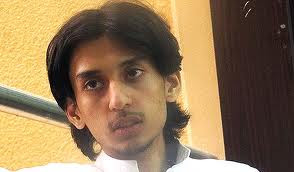
Tweeter Hamza Kashgari
 In three little tweets that came to just over 100 words, Hamza’s life changed forever.   Saudi clerics were outraged and offended by Hamza’s “blasphemous” utterings, calling for him to be charged with apostasy, a crime in the Islamic country of Saudi Arabia which is punishable by death.
The following are the three tweets that shook up the Muslim world so badly that his words triggered the creation of a Facebook group crying for his execution that within a matter of days grew to over 26,000 members:

“On your birthday, I shall not bow to you. I shall not kiss your hand. Rather, I shall shake it as equals do, and smile at you as you smile at me. I shall speak to you as a friend, no more.”
“On your birthday, I find you wherever I turn. I will say that I have loved aspects of you, hated others, and could not understand many more.”
“On your birthday, I will say that I have loved the rebel in you, that you've always been a source of inspiration to me, and that I do not like the halos of divinity around you. I shall not pray for you.”

Hamza’s case has been filled with controversy.  His apology and repentance for his “crime” has not been enough to appease the government, although many feel that his repentance should be adequate. 

The manner in which the Saudi government was able to get their hands on him in the first place was, at best, conniving and deceitful.  Hamza intended to apply for political asylum in New Zealand, but he never made it.  There are no extradition agreements between Saudi Arabia and Malaysia, yet that’s where he was arrested.  Malaysian lawyers have stated, "The initial claim of Interpol's involvement was a blatant attempt to varnish the arrest with a veneer of international legitimacy since the arrest could not be justified under international law as Hamza was clearly a political refugee.” 

Disparaging remarks have been made about Hamza’s heritage, with many Saudis expressing in true tribal mentality that he is “not Saudi enough,” as if no pure or true Saudi would ever say the offensive things that Hamza said.

There might be more to Hamza's case than merely an offense against Islam.  Some surmise that it is politically driven and that the Saudi government is using Hamza as an example to those who might be tempted to instigate rebellion within the country along the lines of the Arab Spring, which didn’t really happen in Saudi Arabia. 

One year later, Hamza still languishes in prison, untried.  In Saudi Arabia, the right to a speedy trial isn’t important. 

Rizana Nafeek ‘s case was also clouded in controversy.  The young Sri Lankan housemaid was beheaded last month here in Saudi Arabia for allegedly killing an infant in her care in 2005.  Many claim that she was railroaded and was not given adequate representation or a fair trial.   The housemaid also withdrew a “confession” that she had made, claiming it was made “under duress.” 
Sri Lankan Housemaid Rizana Nafeek
 Legitimate questions have been raised regarding Rizana's age at the time of the “crime,” with some reports indicating that Rizana was only 15 when the baby died of suffocation.  The baby’s family refused to accept the payment of “blood money,” which would have exonerated the young maid, and instead insisted on her execution. 

Most middle and upper class Saudi families employ housemaids.  It is a well-known fact that some Saudi families mistreat and abuse these domestic workers, who come to the kingdom from poorer countries like India, Indonesia, the Philippines, Ethiopia, and Malaysia.  Many housemaids don’t get any days off and are treated more like slaves than employees, working long hours for very low wages.  

Nisha Varia fromHuman Rights Watch had this to say about the plight of many domestic workers in Saudi Arabia:  "The Saudi justice system is characterized by arbitrary arrests, unfair trials and harsh punishments.  Migrants are at high risk of being victims of spurious charges.  A domestic worker facing abuse or exploitation from her employer might run away and then be accused of theft.  Employers may accuse domestic workers, especially those from Indonesia, of witchcraft.  Victims of rape and sexual assault are at risk of being accused of adultery and fornication."

At this moment in time, more than 45 foreign housemaids are on death row in Saudi Arabia.   Despite worldwide criticism after the execution of Rizana, Saudi Arabia stands firm in defense of its actions.   You see, Saudi Arabia doesn’t really care about its image to the rest of theworld.  

The last case I wish to highlight in this post is that of five-year-old Lama Al Ghamdi.  Lama was raped, tortured, beaten and murderedby her own father, Sheikh Fayhan Al Ghamdi, a well-known Saudi preacher who has appeared on religious programs in the kingdom many times.  Al Ghamdi has admitted that he tortured his daughter.  Lama’s injuries included a crushed skull, broken back, broken arm, and broken ribs, and reports say that she was raped “everywhere.”   There are conflicting reports as to whether Al Ghamdi is still incarcerated or not.  Some reports say that he was jailed for only about four months and was released. 

Murdered 5-yr-old Lama Al Ghamdi
 Global outrage was sparked last week when it was reported that a judge apparently ruled that the few months that Al Ghamdi already served in jail was adequate punishment and ordered him to pay “blood money” (about $50,000 US).   Anothercourt date is set in about two weeks’ time. 

Three very different cases.  We already know the tragic outcome of Rizana’s case.  The other two cases have not yet played out.  Saudi Arabia’s own brand of “justice” discriminates against foreign workers, political activists, females, and children.   When I read about cases like these in the news, I cannot help but think that Saudi Arabia has screwed up priorities and values and is in total denial about what a dysfunctional society it really is.   

Friday, February 1, 2013

A Whole New Spin on "WALL-MART"


I really try my best to present a balanced view of Saudi Arabia, but there are certain times when some issues just drive me batty.  Gender segregation here is taken to such an extreme here that it tends to create many more problems than those they are trying to resolve - not to mention making Saudi Arabia look like an absurdly backward place where men are not held accountable for their actions, and the blame and punishment is usually aimed at women.  Weddings are segregated affairs, restaurants have separate entrances and dining areas for families and single men, even many private family gatherings I've attended have been segregated.

At a local mall event, notice how the men and women are mostly segregated, left and right.

The latest edict regarding gender segregation comes from the Minister of Labor Adel Faqieh, who has been seen in the past as a rather progressive guy because of his support of women in the workplace.  But now from the Saudi labor department there is a new order that requires the building of 1.6 meter high walls inside businesses to separate working men and women.  Yeah – you heard that right.  Now keep in mind that these working Saudi women are already completely draped in black cloaks, hair completely covered, and many also wear veils over their faces.  

Is this way of dress alone not enough of a barrier?

When I first moved to Saudi Arabia five years ago, there were no women working in sales positions in stores or malls - because they weren't allowed to.  In fact most women in the kingdom were restricted to working in female only educational facilities or in the medical field, where mostly foreign women have been permitted to work as nurses or lab techs side by side with men.   Saudi women in medicine generally are doctors or researchers.

Nowadays Saudi women work in lingerie shops.  Men can only enter these shops when accompanied by female family members.


It was bad enough – and downright creepy - that women here in Saudi Arabia were forced until recently to purchase their undies from men, when the women organized and demanded that women be put in these types of sales positions, including lingerie and cosmetics shops.   Their voices were heard and the King ordered that these salesmen be replaced with women.  It was a huge victory for women in Saudi Arabia.  This eventually led to women being employed in supermarkets, department stores, and women’s clothing shops. 

Saudi female cashiers in the supermarket chain HyperPanda here in Jeddah

Shopping here in Saudi Arabia - at grocery stores, malls, and even small shops - has always been mixed and has never been gender segregated.  As a friend of mine pointed out recently, this "problem" that exists now seems to stem from the fact that women are the ones earning the money instead of just spending it.   It was always okay here when men were the workers and women were the customers, but now that women are working in fields that were formerly dominated by men, the religious bigwigs are suddenly having tizzy fits.  

Why is it okay for this type of gender interaction, but not when the female is the one behind the counter?
In a group discussion about this new development to prevent gender mixing in the workplace, one participant said:  For a country with such high religiosity, it appears that the Saudi adult citizens cannot be trusted to behave with morals and manners in the most basic social and community settings.  I call this a RED FLAG ... Obviously something is desperately wrong. When people are raised with such strict religious laws, norms / values and the government's actions repeatedly imply that Saudi citizens lack basic self-control and are not capable of social interaction with the opposite sex for fear of combustible consensual sexual intercourse, molestation, or rape ... Where else in the world does such a problem exist? Seriously! What is taking place in Saudi society and its institutions that would cause the Saudi government to assume that its citizens' behaviors are so spiritually bankrupt?

Is it better for Saudi women to just beg instead of working a real job?
So exactly what has prompted this move from the Ministry of Labor?  Since women began working in other venues a few short years ago, I would ask - have there been incidents or problems with working women being harassed or complaints about men they work with?  None that I am aware of have been reported in the news, although one article I read vaguely hinted that there have been complaints, but nothing specific.  

Or does it perhaps have to do with the deadly threats from 200 members of the country’s religious police force causing a ruckus in late December 2012, whereby these “Men of God” told the Minister of Labor that if he didn’t do something to stop Saudi women from mixing with men in the workplace that they would pray that Faqieh gets cancer and dies?  Nice, huh?  Especially sweet coming from "Men of God."
 
I think I have a much better and easier solution.  Why not give the men in Saudi Arabia a chance to prove that they can behave themselves around women in the workplace?  And if they can’t manage to do that, then just FIRE THEIR ASSES!!!  

Child molester, torturer and murderer Sheikh Fayhan Al Ghamdi
I'm getting off topic here now, but what I really want to know is:  why aren’t these religious guys (who are so concerned with protecting morality and female virginity) focusing on more important things that pertain to women and children here?  For example, why aren’t they totally unhinged about the recent ruling in the case of the Islamic preacher, Sheikh Fayhan AlGhamdi?  Al Ghamdi brutally raped and tortured his own five year old daughter in December of 2011.  She remained in a coma in the hospital and finally succumbed to her horrendous injuries some 10 months later, in October 2012.  

The judge in the case has recently ruled that the few months Al Ghamdi spent in jail was enough and all he has to do now is pay the family of the victim “blood money.”  Here in Saudi Arabia, the so-called "justice system" in place is along the lines of “an eye for an eye” and provides for financial compensation paid to the heirs of the victim.  In this case, the girl’s family or heirs would include her own father who heinously killed her.  However, the paying of blood money should only apply when the killing was unintentional.  It was obvious that the injuries suffered by this poor girl were not an accident. 

So why isn’t the religious establishment here in Saudi Arabia demanding Al Ghamdi’s head on a platter instead of concerning themselves with such trivial matters as building barriers to separate men and women in the workplace?   I don’t get it.

For more reading on these subjects: 


From Saudi Woman, Eman Al Nafjan:  Rest in peace, Lama