
Last month I took a little trip down to the city of Najran, in southern Saudi Arabia near the Yemen border. The fascinating history of the area, the friendly people, along with the varied geography make this place a must-see destination for any expat living in Saudi Arabia.

Najran is nestled in a fertile farming valley surrounded by rocky mountains and rolling deserts. The abundance of date palms adds to the scenic landscapes and provides a visual treat for the eyes. Farming is an important industry in Najran, with fields of crops stretching for miles. The fertile soil is suitable for growing crops such as corn, wheat, zucchini, and a wide variety of fruits like apples, peaches, citrus, and grapes.

Coupled with the distinctive architectural style of the region, Najran is a city that magic carpet dreams are made of. All over Najran, mixed in with the new construction, are the unique old mud and straw houses, some of them in ruins, but many of them not only standing, but still inhabited. Another distinguishing feature of these homes is the decorative white "bride's lace" designs at the roof lines that add unmistakable charm to the buildings.

Our group was invited into one of these modest mud homes by lifelong residents Ahmed, who is in his 80s, and his wife Umm Mohammed. They were gracious hosts, offering us the traditional gahwa (Arabic coffee) and dates which we enjoyed in their sitting room. We toured the home from bottom to top, viewing the fields and mountains from their various rooftop decks about 4 floors up. Because of its close proximity to Yemen, many of Najran's residents are of Yemeni heritage, as are Ahmed and his wife, and the architectural style of the mud homes is also an influence of Yemen.
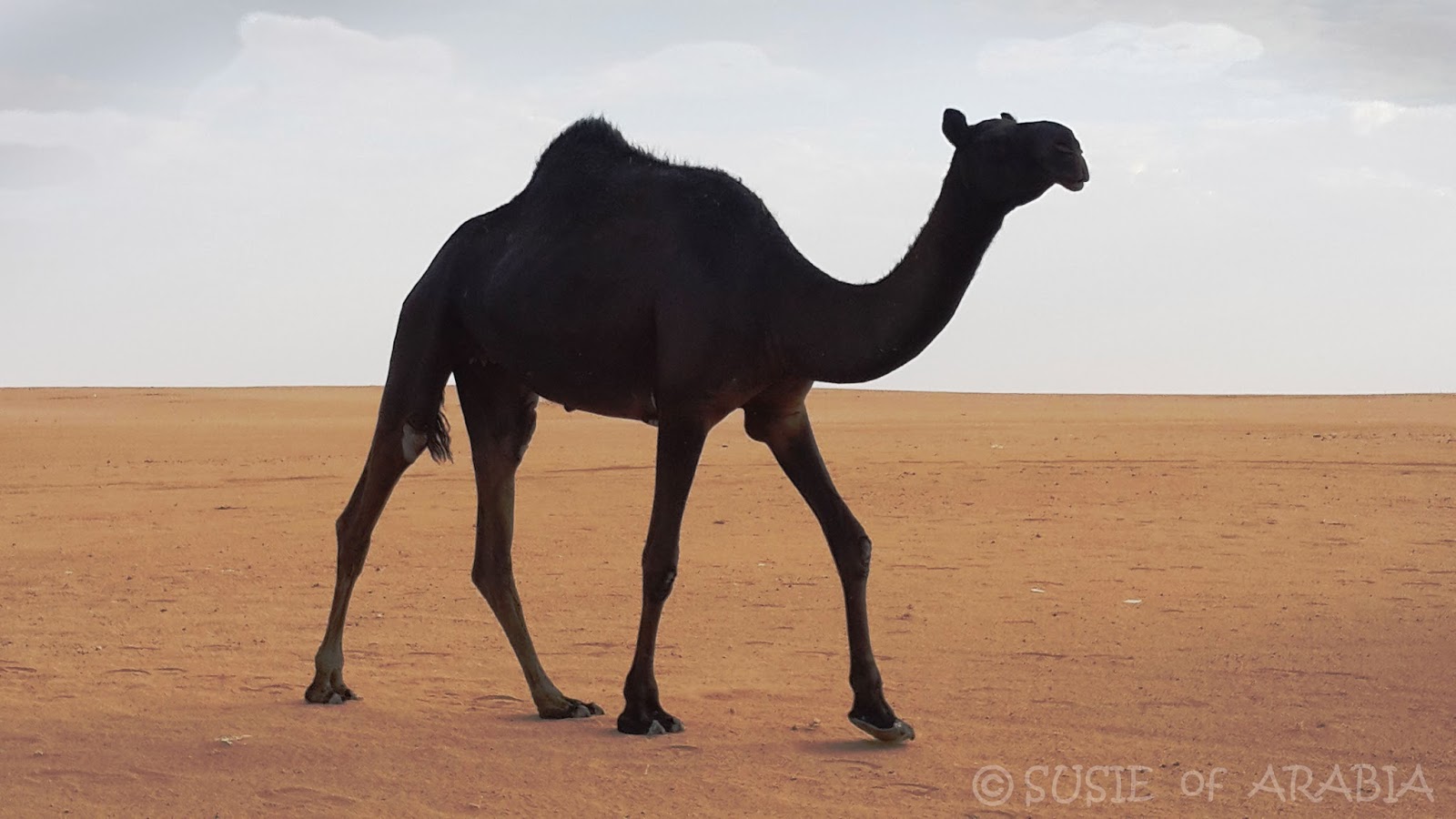
Camels are everywhere in and around Najran. The camel souq is where camels are bought and sold, along with fresh camel milk. On our excursion outside the city into the desert, we saw many groups of camels that were being trained to compete in races. We were also treated to a Bedouin cookout one perfect evening under the stars at a desert camp, complete with carpets, tents, camel meat, hookahs, and a campfire. The only thing missing was the marshmallows!

A highlight of our trip was a visit to the main souk of Najran which houses a dagger souk. The traditional curved Arab daggers, called khanjar, are offered for sale here, with elegant carved handles made of bone, metal, wood, or plastic. The men of the dagger souk all proudly wore their traditional Arab clothing, accessorized with their khanjars strapped around their waists on a leather belt. Another section of the souk offered products like handmade baskets, jewelry, and clothing.
Several of the dagger shopkeepers took turns posing for photos with me. It felt like the paparazzi was around as the others all gathered around us to take photos with their state of the art phones. I could tell by the frequent laughter that jokes were being made as we posed for pictures. Later I learned that the conversation went something like this:
"Mohammed, you better not let your wife see that picture of you and this woman. She will get jealous."
"You've been thinking of getting a 3rd wife - how about this American?"
"My wives will kill me if I do that!"

Even though people have lived in the Najran area for about 4000 years, it is considered to be a newer and more modern city because of its remarkable growth spurt since the 1970s. Najran's population now exceeds 250,000. We toured the historic Emara Palace, built in the 1940s - a fine example and tribute to the distinctive architecture of the region. Another well known palace in the area, Al-Aan Palace, is built on hilltop and offers spectacular views of the surrounding area, overlooking the oasis of Najran.
Interestingly enough in pre-Islamic days, Najran used to be inhabited by predominantly Jews and Christians. There is an old archaeological site in the city that bears the ruins of Al-Okhdood (also spelled Ukhdood). According to a story in the Q'uran, this is where a disgruntled Jewish king massacred thousands of its residents by burning them alive because they converted to Christianity. Quite a gruesome history. Rock drawings of animals and cryptic writings are visible all over Al-Okhdood. The site is still in the process of being excavated and to date has produced important historical artifacts, with much more still hoped to be retrieved.

Spectacular scenery and fascinating history aside, what really makes Najran such a memorable place is its people. Warm and welcoming, open and friendly, the people of Najran are hospitable and accommodating.

If you are interested in planning a trip to Najran, I highly recommend Mohammad of Najran Tours. He is professional, knowledgeable, and flexible and will tailor your visit to your preferences. Here is the information for Najran Tours:
Mohammad H. Al Mustaneer
Najran Tours.
Reg. No. : 5950026097
Najran, Saudi Arabia
Mob. +966 552 498 012
+966 550 377 715
najrantours@gmail.com
www.najrantours.com
Facebook page for Najran Tours
Tell him Susie sent you!
I put together a slideshow for you with lots more photos from my trip to Najran. Enjoy!
Najran is nestled in a fertile farming valley surrounded by rocky mountains and rolling deserts. The abundance of date palms adds to the scenic landscapes and provides a visual treat for the eyes. Farming is an important industry in Najran, with fields of crops stretching for miles. The fertile soil is suitable for growing crops such as corn, wheat, zucchini, and a wide variety of fruits like apples, peaches, citrus, and grapes.
Coupled with the distinctive architectural style of the region, Najran is a city that magic carpet dreams are made of. All over Najran, mixed in with the new construction, are the unique old mud and straw houses, some of them in ruins, but many of them not only standing, but still inhabited. Another distinguishing feature of these homes is the decorative white "bride's lace" designs at the roof lines that add unmistakable charm to the buildings.
Our group was invited into one of these modest mud homes by lifelong residents Ahmed, who is in his 80s, and his wife Umm Mohammed. They were gracious hosts, offering us the traditional gahwa (Arabic coffee) and dates which we enjoyed in their sitting room. We toured the home from bottom to top, viewing the fields and mountains from their various rooftop decks about 4 floors up. Because of its close proximity to Yemen, many of Najran's residents are of Yemeni heritage, as are Ahmed and his wife, and the architectural style of the mud homes is also an influence of Yemen.
Camels are everywhere in and around Najran. The camel souq is where camels are bought and sold, along with fresh camel milk. On our excursion outside the city into the desert, we saw many groups of camels that were being trained to compete in races. We were also treated to a Bedouin cookout one perfect evening under the stars at a desert camp, complete with carpets, tents, camel meat, hookahs, and a campfire. The only thing missing was the marshmallows!
A highlight of our trip was a visit to the main souk of Najran which houses a dagger souk. The traditional curved Arab daggers, called khanjar, are offered for sale here, with elegant carved handles made of bone, metal, wood, or plastic. The men of the dagger souk all proudly wore their traditional Arab clothing, accessorized with their khanjars strapped around their waists on a leather belt. Another section of the souk offered products like handmade baskets, jewelry, and clothing.
 |
| Men of the dagger souq - Najran, Saudi Arabia |
Several of the dagger shopkeepers took turns posing for photos with me. It felt like the paparazzi was around as the others all gathered around us to take photos with their state of the art phones. I could tell by the frequent laughter that jokes were being made as we posed for pictures. Later I learned that the conversation went something like this:
"Mohammed, you better not let your wife see that picture of you and this woman. She will get jealous."
"You've been thinking of getting a 3rd wife - how about this American?"
"My wives will kill me if I do that!"
 |
| Emara Palace - Najran, Saudi Arabia |
Interestingly enough in pre-Islamic days, Najran used to be inhabited by predominantly Jews and Christians. There is an old archaeological site in the city that bears the ruins of Al-Okhdood (also spelled Ukhdood). According to a story in the Q'uran, this is where a disgruntled Jewish king massacred thousands of its residents by burning them alive because they converted to Christianity. Quite a gruesome history. Rock drawings of animals and cryptic writings are visible all over Al-Okhdood. The site is still in the process of being excavated and to date has produced important historical artifacts, with much more still hoped to be retrieved.
Spectacular scenery and fascinating history aside, what really makes Najran such a memorable place is its people. Warm and welcoming, open and friendly, the people of Najran are hospitable and accommodating.
If you are interested in planning a trip to Najran, I highly recommend Mohammad of Najran Tours. He is professional, knowledgeable, and flexible and will tailor your visit to your preferences. Here is the information for Najran Tours:
Mohammad H. Al Mustaneer
Najran Tours.
Reg. No. : 5950026097
Najran, Saudi Arabia
Mob. +966 552 498 012
+966 550 377 715
najrantours@gmail.com
www.najrantours.com
Facebook page for Najran Tours
Tell him Susie sent you!
I put together a slideshow for you with lots more photos from my trip to Najran. Enjoy!


