Saturday, April 4, 2015

Saudi Arabia's first female detective trained in U.S.


As a former police officer myself, I was quite excited when I saw this news video of Nadeen Alsayat, the first Saudi female trained for police work.  Nadeen recently graduated from Colorado University with a Master's Degree in Criminal Justice paid for by the Saudi government and will become Saudi Arabia's first female detective.  She spent six months interning with the Commerce City Police Department in Colorado.

In addition to Nadeen's accomplishment in the USA, Saudi Arabia will be graduating its first ever class of female police officers as well this year.  Congratulations to Nadeen on achieving her childhood dream of becoming a police officer - and congratulations to the graduating class in KSA for leading the way for other females to break into careers that were previously taboo for Saudi women.

To read more about Nadeen Alsayat's training experience, CLICK HERE.

Saturday, February 28, 2015

First Wives Club


I used to be able to count on one hand the number of women I personally know whose Saudi husbands married a second wife.  Those days are gone.  Sadly now that number exceeds all the fingers on both hands and all of my toes as well.  As many of you know, Saudi Arabia is governed by Sharia Law which comes from the Quran, the holy book of Islam.  Islam allows men to be married to up to four different women at the same time. 


Muslim scholars and Muslim men seem to be proud of the fact that the Quran is the only holy book that actually states “Marry only one (wife).”  I hear them boast about this all the time!  Why then are so many Muslim men taking on more than wife?  I find this amusing, since polygyny is permitted in Islam but not encouraged.  I just hate it when I hear men here saying that it is their God-given right.  Pfffft!

The original idea for this arrangement is centuries old and was borne out of the necessity of the times.  Men would go off to war, get killed, and there was an abundance of widows and orphans left behind that needed to be protected and provided for.  It was affirmed to be man's “social responsibility,” which begs the question:  Why exactly does a man have to marry a second woman to fulfill his social responsibility?  Especially when the Quran clearly says "Marry only one"???  Aren’t there other socially acceptable ways to provide for needy people other than marriage?  How about charity?  Why do men have to introduce sex into the equation in order to fulfill their social responsibility?

Many Muslim men like to make the claim that there are SO many more women in the world than men, and while that may have been the case centuries ago, statistically speaking, this is no longer a valid argument.  In today’s world, all recent statistics clearly show that men now outnumber women in births (107 to 100) and in the world population (101 to 100).

Yes, there are some countries in the world where women outnumber men, but in the total overall, there are more men.  And Saudi Arabia – where men can marry up to four women - is one of the majority countries that actually has more men than women - so this contention just doesn't hold water any more.

Another reason given for why polygyny is allowed in Islam is to allow a man whose wife cannot bear children to marry another woman who can have babies so he can produce heirs.  The problem with this assertion is that frequently the man is the one with fertility problems - so this excuse for multiple wives should at least have a provision that the man should be checked first to make sure he is not the one with sterility problems - don't cha think?  

 
I’ve even heard proponents of the multiple wives policy come up with the reasoning that there are so many gay men in the world - so obviously gay men don't count as eligible men in the marriage pool.  Hello?  They always seem to overlook the fact that there are also plenty of lesbians in the world too who don’t want to marry men either.  Moot point.  

And probably the most "honest" excuse I have heard for why polygyny is allowed in Islam is because men just naturally have a stronger sex drive and want to have sex with a variety of women.  So polygyny allows men to do this under the sanctity of marriage to prevent either of the participants from committing a grave sin, according to religion.  However, this argument totally discounts the female’s sex drive and presumes incorrectly that only men have strong sexual urges.  

So in Islam, a woman who becomes a second wife (or third or fourth) is considered by many as doing an "honorable" thing.  But somehow I really don’t think there are too many first wives out there who would actually agree with that statement.   

My thoughts on this are that there are three possible situations where a woman might become a second wife:  
1 – She is a desperate divorcee or widow and wants the security for herself and her children.  
2 – She becomes a second wife unwittingly because the man wasn’t honest with her.   
3 – She actively pursues a married man because she sees that he is wealthy and she doesn’t care that she is destroying a marriage and a family in the process.  

I personally know of women here in Saudi Arabia fitting all of these scenarios.  To be continued…

Wednesday, February 18, 2015

Chapel Hill Vs Copenhagen - Which Is Terrorism?

Comedian and actor Russell Brand may strike some people as uncouth or vulgar, but he is spot on about the media's portrayal of Muslims as terrorists. 


Wednesday, November 26, 2014

The Abaya - Back in Black

There has been a lot of discussion lately about what women in Saudi Arabia must wear when they are out in public.  That traditionally black cloak worn over her clothing that hides the female form is called the abaya, and lately there have been heated discussions about whether colored abayas should be permitted or not.  My husband has told me that when he was growing up in Jeddah, women did not wear abayas.  Of course women dressed modestly, but they wore what they wished in terms of colors and styles, and they weren't obligated to wear the uniform of the black abaya.  It wasn't really until about the 1990s when religious police began forcing women to wear the abaya in public.

Beige/Taupe/ Black Abaya with Turquoise Trim
But why black, you may ask?  There is really no reason at all for women to wear black.  Somehow it became the only color worn in Saudi Arabia, although there is certainly no rule, law or regulation about the color being only black.  Some religious authorities have thrown fits these past few years with the introduction of colors and embellishments to satisfy women's preferences and individuality. The opposition claims that embellishments and colors attract attention and are not modest.  I guess black is the only color they consider "modest."   The purpose of the abaya is to dress modestly, obscuring the female curves, loosely covering all but the hands and face.  Whether an abaya is black or not shouldn't really matter.  To be forced to wear black in the brutal heat of Saudi Arabia is inhumane.  And unless the government is going to provide black abayas for all the women in Saudi Arabia to wear, how we choose to express ourselves through our abayas should be up to us.  My personal opinion is that men want women to wear black in Saudi Arabia so they will be less inclined to venture out in the heat.  It is a way for men to maintain control and keep women at home because it's just too darn hot to go outside wearing black.

Black Abaya with Pink Camouflage Sleeves
What really bugs me is that people in KSA try to say that women should wear black abayas because of religious teachings.  No where does Islam say that a woman must wear an abaya, and no where does it say that the abaya must be black.  Islam requires both men and women to dress modestly - that's it.  Another thing that bugs me is that according to Islam, men are supposed to lower their gazes and not look at women. So what does it matter what color I am wearing if men aren't supposed to be looking anyway?  Men need to mind their own business and quit trying to control every aspect of women's lives, down to what color she should wear.  It's ridiculous. 

Black Abaya with White Flowers
A disturbing and discouraging article appeared this past week in the Arab News regarding a campaign which has been started at Dammam University opposing colorful abayas.  The article states that "female students are required to abide by the rule of wearing black as a sign of respect to the educational environment."  As if students wearing colors other than black are disrespectful to teachers and other students and that they cannot learn if they are wearing colors.   What I feel is disrespectful is someone trying to dictate to me what color I should wear.  You can read this enlightening blog post written by SaudiWoman a few years ago explaining "Abaya Regulations" and dress code enforcement at schools in Saudi Arabia.

Brown Abaya
I just love how I am always told that there is no compulsion in Islam, however it seems that not only am I forced to wear the abaya, but now they want to go so far as to limit my color choice to black.   So what is it? Compulsion or not?

Currently there is a "survey" on Arab News asking:  Do you think colorful abayas should be avoided? Yes or No?  The poll is running neck and neck.  Personally I don't like the way the survey is worded - it has a negative connotation, insinuating that color should be something  to "avoided."  

Blue Abaya with African Print Sleeves and Back
Don't men have more important things to do than worry about what colors women are wearing? Women are getting killed in car crashes daily here in Saudi Arabia because we are not allowed to drive.  We are at the mercy of incompetent male drivers who drive recklessly, putting everyone in harm's way.  Why isn't more attention paid to this issue instead of what color I am wearing?

Back View of  the Blue Abaya above
Men in Saudi Arabia are allowed to wear pretty much whatever they want to wear - any color, any style of dress.  I've seen men out in public in KSA in attire that I can only describe as suitable for wearing in the privacy of one's own home.  They literally look as if they just crawled out of bed and went out the door. Nobody ever says a word about this.  Maybe it's time we did - especially since women are getting picked on because we don't all want to look the same wearing boring black every single day, while men are permitted to wear bedclothes out in public. I object!

Beige and Brown Abaya with Gold Embroidery
It's bad enough that we have to wear layers of clothing in the sweltering heat of Saudi Arabia.  I'll be damned if I will be forced to wear only black.  I am happy to see colorful abayas now in the shops, and a wider variety of styles and fabrics to choose from. I actually enjoy abaya shopping now.

Print Top with Black Skirt Abaya
By the way, the abayas featured in this post all belong to me. I made a few of them myself, and some I bought.  I apologize for the bad quality of the images.

Sunday, November 16, 2014

Enchanting Najran - Saudi Arabia

Last month I took a little trip down to the city of Najran, in southern Saudi Arabia near the Yemen border. The fascinating history of the area, the friendly people, along with the varied geography make this place a must-see destination for any expat living in Saudi Arabia.


Najran is nestled in a fertile farming valley surrounded by rocky mountains and rolling deserts. The abundance of date palms adds to the scenic landscapes and provides a visual treat for the eyes. Farming is an important industry in Najran, with fields of crops stretching for miles. The fertile soil is suitable for growing crops such as corn, wheat, zucchini, and a wide variety of fruits like apples, peaches, citrus, and grapes.


Coupled with the distinctive architectural style of the region, Najran is a city that magic carpet dreams are made of. All over Najran, mixed in with the new construction, are the unique old mud and straw houses, some of them in ruins, but many of them not only standing, but still inhabited. Another distinguishing feature of these homes is the decorative white "bride's lace" designs at the roof lines that add unmistakable charm to the buildings.


Our group was invited into one of these modest mud homes by lifelong residents Ahmed, who is in his 80s, and his wife Umm Mohammed. They were gracious hosts, offering us the traditional gahwa (Arabic coffee) and dates which we enjoyed in their sitting room. We toured the home from bottom to top, viewing the fields and mountains from their various rooftop decks about 4 floors up. Because of its close proximity to Yemen, many of Najran's residents are of Yemeni heritage, as are Ahmed and his wife, and the architectural style of the mud homes is also an influence of Yemen.
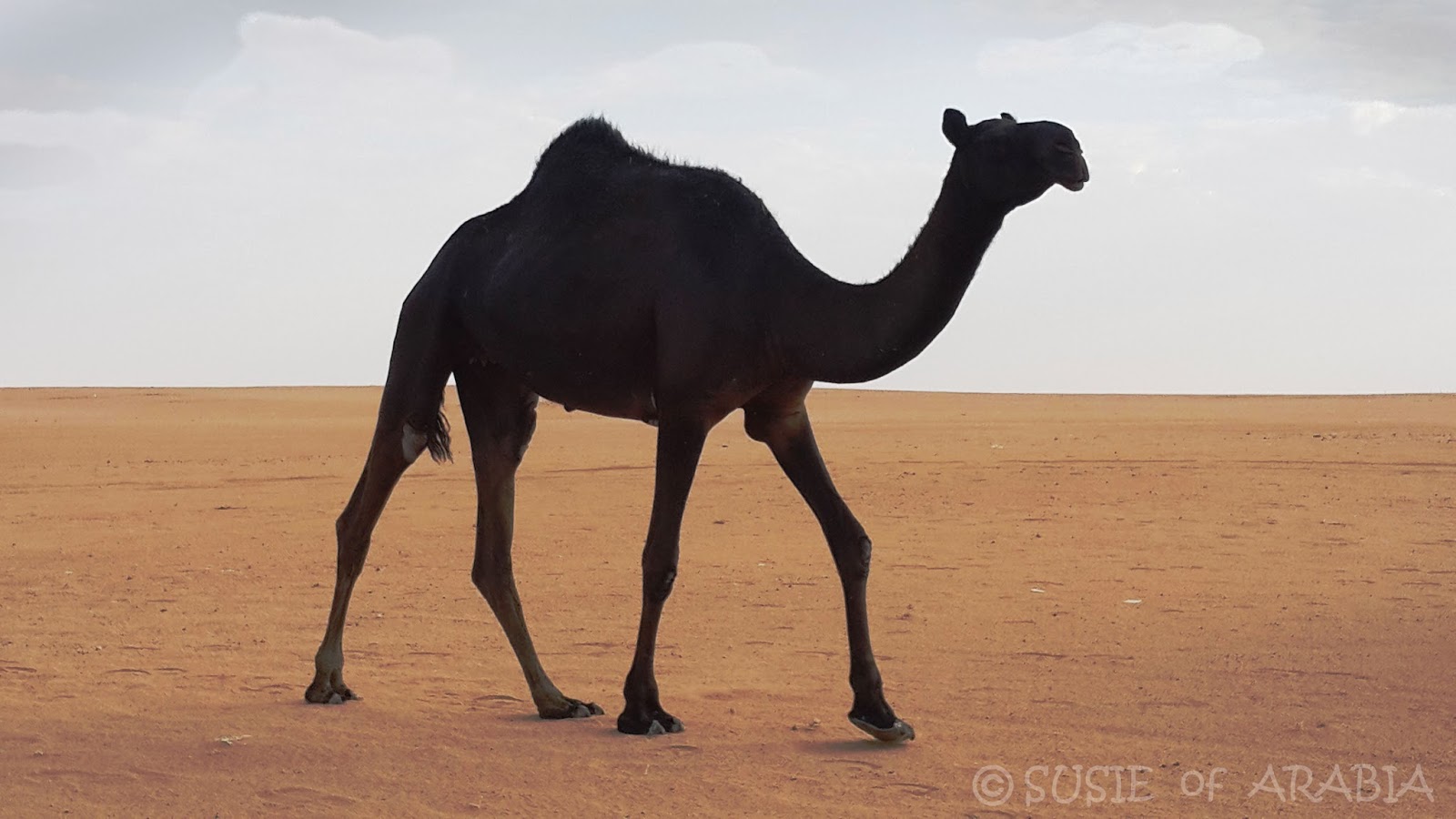


Camels are everywhere in and around Najran. The camel souq is where camels are bought and sold, along with fresh camel milk. On our excursion outside the city into the desert, we saw many groups of camels that were being trained to compete in races. We were also treated to a Bedouin cookout one perfect evening under the stars at a desert camp, complete with carpets, tents, camel meat, hookahs, and a campfire. The only thing missing was the marshmallows!


A highlight of our trip was a visit to the main souk of Najran which houses a dagger souk. The traditional curved Arab daggers, called khanjar, are offered for sale here, with elegant carved handles made of bone, metal, wood, or plastic. The men of the dagger souk all proudly wore their traditional Arab clothing, accessorized with their khanjars strapped around their waists on a leather belt. Another section of the souk offered products like handmade baskets, jewelry, and clothing.

Men of the dagger souq - Najran, Saudi Arabia


Several of the dagger shopkeepers took turns posing for photos with me. It felt like the paparazzi was around as the others all gathered around us to take photos with their state of the art phones.  I could tell by the frequent laughter that jokes were being made as we posed for pictures. Later I learned that the conversation went something like this:
"Mohammed, you better not let your wife see that picture of you and this woman. She will get jealous."
"You've been thinking of getting a 3rd wife - how about this American?"
"My wives will kill me if I do that!"


Even though people have lived in the Najran area for about 4000 years, it is considered to be a newer and more modern city because of its remarkable growth spurt since the 1970s.  Najran's population now exceeds 250,000.  We toured the historic Emara Palace, built in the 1940s - a fine example and tribute to the distinctive architecture of the region.  Another well known palace in the area, Al-Aan Palace, is built on hilltop and offers spectacular views of the surrounding area, overlooking the oasis of Najran.

Emara Palace - Najran, Saudi Arabia


Interestingly enough in pre-Islamic days, Najran used to be inhabited by predominantly Jews and Christians. There is an old archaeological site in the city that bears the ruins of Al-Okhdood (also spelled Ukhdood).  According to a story in the Q'uran, this is where a disgruntled Jewish king massacred thousands of its residents by burning them alive because they converted to Christianity. Quite a gruesome history.   Rock drawings of animals and cryptic writings are visible all over Al-Okhdood. The site is still in the process of being excavated and to date has produced important historical artifacts, with much more still hoped to be retrieved.


Spectacular scenery and fascinating history aside, what really makes Najran such a memorable place is its people. Warm and welcoming, open and friendly, the people of Najran are hospitable and accommodating.


If you are interested in planning a trip to Najran, I highly recommend Mohammad of Najran Tours. He is professional, knowledgeable, and flexible and will tailor your visit to your preferences. Here is the information for Najran Tours:

Mohammad H. Al Mustaneer
Najran Tours.
Reg. No. : 5950026097
Najran, Saudi Arabia
Mob. +966 552 498 012
+966 550 377 715
najrantours@gmail.com
www.najrantours.com
Facebook page for Najran Tours

Tell him Susie sent you!

I put together a slideshow for you with lots more photos from my trip to Najran.  Enjoy!


Saturday, November 8, 2014

Saudi Women Have Fun!


Enjoy this very short video that gives you a glimpse into the lighter side of living in Saudi Arabia. Even though women cannot drive here yet, they can still manage to have fun.

Tuesday, November 4, 2014

Dona Nobis Pacem - Blogging for Peace in 2014


Dona Nobis Pacem - is Latin for "Grant Us Peace."

I have dreamed of a world of peace for as long as I can remember.  When I was a child in 1950s, I would often have difficulty falling asleep because of all the images swirling around in my head of Nikita Khrushchev threatening to bury me, the Cold War, and the Nuclear Arms Race.  I had nightmares.  It is a scary thing for a child who doesn't understand why everyone just can't get along or why there are wars in the first place.

As the decades passed, my difficulties in falling asleep remained, but what changed were who the Bad Guys were and the different fears.  Like Fidel Castro, the Viet Nam War, the Iran Hostage Crisis, the bombings in Northern Ireland, and the never ending conflicts involving Middle Eastern and African countries.


I still don't claim to understand the motivations or reasons behind all this worldwide turmoil.  But what I do know is that  I choose not to live in fear - and I am already against the next war.  That, for me, will never change.

We must change the world so our children don't have to be afraid, so they don't have nightmares, and so our children can know a World of Peace.

Today, November 4th, bloggers from all around the world are uniting together and Blogging for Peace.  Maybe somehow if enough of us stand up together and say "Enough is Enough" - maybe, just maybe, we can Give Peace a Chance.

Blog4Peace Website

Blog Blast for Peace Facebook Community